
1
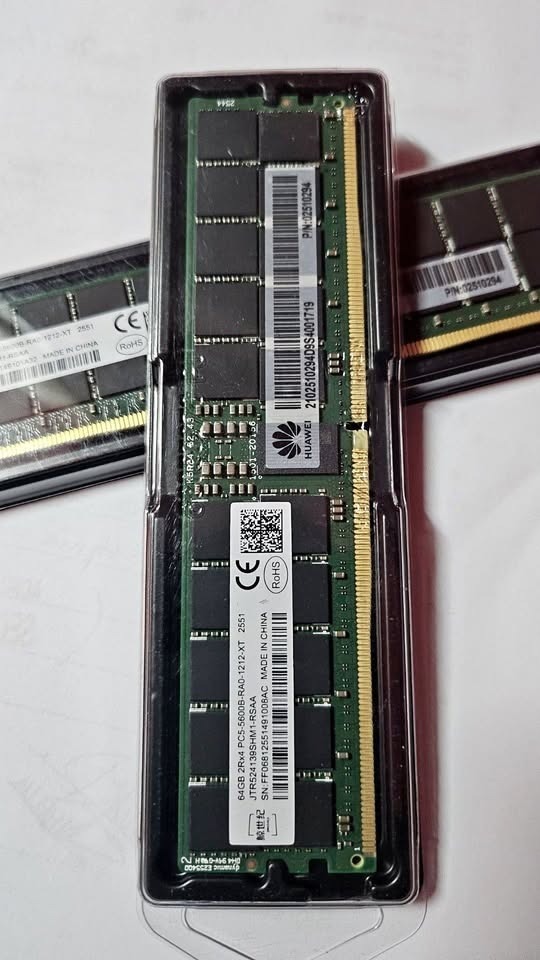
Description
Core Performance Metrics
-
- Memory Capacity: 64GB (Single module configuration).
- Data Transfer Rate: 5600 MT/s (MegaTransfers per second).
- Operating Frequency: 5600 MHz effective clock speed.
- Module Bandwidth: PC5-44800 (Peak data transfer bandwidth of 44.8 GB/s per module).
- JEDEC Speed Bin: 5600B.
- CAS Latency (CL): CL46 (Standard JEDEC timing baseline of 46-45-45 at native voltage). [1, 2, 3, 4, 5, 6, 7]
Architecture & Electrical Specifications
-
- Form Factor: 288-pin Registered DIMM (RDIMM). Note: This is strictly hardware-incompatible with standard desktop UDIMM slots.
- Memory Rank Layout: 2Rx4 or 2Rx8 (Commonly Dual-Rank x4 configuration for maximized enterprise bus widths).
- Component Composition: Uses a high-density configuration typically based on 16Gb or 24Gb monolithic DRAM dies.
- Operating Voltage: Ultra-low 1.1V VDD baseline (Provides up to an 8% power reduction over legacy DDR4 modules).
- Programming Supply Voltage (VPP): 1.8V.
- Power Management: Includes an On-Module PMIC (Power Management Integrated Circuit). This shifts voltage regulation from the server motherboard to the RAM module itself, optimizing signal integrity and lowering thermal overhead. [1, 2, 3, 4, 5, 6]
Data Integrity & Reliability features
-
- Signal Processing: Registered / Buffered. Employs a hardware register clock driver (RCD) to buffer the command and address signals, substantially reducing electrical loading on the host CPU memory controller. [1, 2]
- Error Correction Code (ECC): Sideband ECC (EC8 / 72-bit/80-bit wide bus). Detects and corrects single-bit memory faults dynamically, preventing system panics or data corruption.
- On-Die ECC (ODECC): Native DDR5 architectural feature providing internal chip-level cell error management prior to data being transmitted to the system bus. [1, 2]
Physical & Thermal Standards
Related products
-
Sale!

Lenovo Tiny M73/M93 Core i3 4th Gen 4GB Ram 500GB HDD
Original price was: R1800,00.R1750,00Current price is: R1750,00. Add to cart -
Sale!

Refurbished HP Elitedesk 600,800 G1 Core i5 4th Gen 4GB Ram 500GB HDD
Original price was: R1700,00.R1500,00Current price is: R1500,00. Add to cart -

Certified Pre-Owned Dell OptiPlex 7050 Tiny PC – Intel i5 7th Gen 8GB/256GB SSD
R2700,00 Add to cart -
Sale!

DELL 6-in1 USB-C DA305 MOBile Docking station (NEW)
Original price was: R2000,00.R1500,00Current price is: R1500,00. Add to cart
Reviews
There are no reviews yet.